The Dark Sector, Explained: What If the Invisible 95% Is an Extra Dimension?
September 15, 2026 · Updated September 27, 2026
Research Notes
The idea that dark matter and dark energy are not new substances but the shadow of a fifth dimension — and the one, surprising place the theory says we might actually see it.
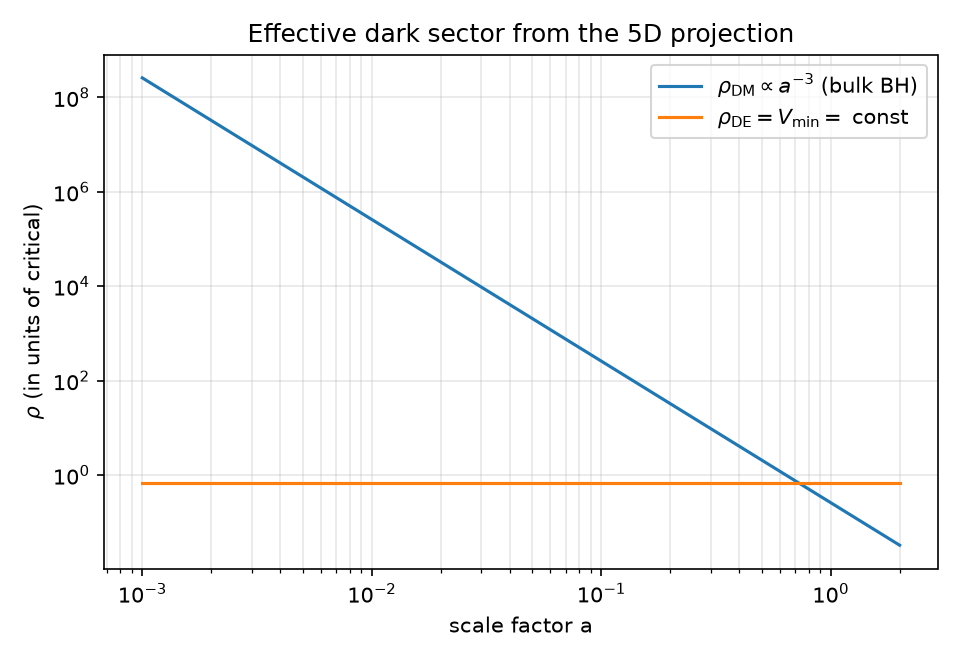
Research Notes — Part 2 of a series on the dark sector as a fifth-dimensional effect.
Everything we can see, touch, and measure — every atom, every star, every galaxy — adds up to about five percent of the universe. The other ninety-five percent is invisible, and the physics we trust has no word for it.
This is the dark-sector problem, and it is the deepest gap in modern science. This note traces the story: what is missing, one bold idea for what it might be, and the single, surprising place where the idea says we could actually catch it in the act.
The Missing Ninety-Five Percent
Physics has two great pillars. The Standard Model describes every known particle and three of the four forces with astonishing precision. General relativity describes gravity. Together they account for all the matter and energy we have ever directly observed.
And yet, when we point them at the universe as a whole, two things show up that neither pillar contains:
- Dark matter — an invisible substance that tugs on galaxies. Stars on the outskirts of galaxies orbit too fast for the visible mass; clusters of galaxies are far heavier than their glowing contents; and the pattern of the cosmic microwave background only makes sense if cold, non-luminous matter was present from very early on.
- Dark energy — something that is making the expansion of the universe speed up, an effect discovered in 1998 and measured ever since.
The resulting cosmic inventory is stark:
| Component | Share of the universe |
|---|---|
| Ordinary matter (everything we can see) | ~5% |
| Dark matter | ~27% |
| Dark energy | ~68% |
The uncomfortable truth is not that these components are hard to detect. It is that they are absent from the theory altogether. There is no particle in the Standard Model that could be dark matter, and no field that could be dark energy.
Two Ways Out
Faced with a gap this large, physicists line up behind one of two positions.
The first is fundamental: dark matter is a real, undiscovered particle, and dark energy is a new field or a true constant. We simply have not found them yet. This is the mainstream bet, and an enormous experimental effort is devoted to it.
The second is emergent: the dark sector is real in its effects but not fundamental. It is what a four-dimensional observer sees when the universe actually has more than four dimensions — an effective description of physics our vantage point cannot fully access.
The word “emergent” matters. Temperature is real, but no single molecule has a temperature; it is a description of the collective motion of many molecules. Sound is real, but it is not a substance — it is what pressure waves look like to our ears. The second position asks: could dark matter and dark energy be the same kind of thing — real, but emergent?
The rest of this note follows that second idea, because it is the one that connects to a fifth dimension.
The Idea: An Extra Dimension
From Part 1 we have the tool: a higher-dimensional space is a stack of lower-dimensional worlds, and our universe could be a single slice of a five-dimensional one.
That turns out to be more than a metaphor. In the early twentieth century, Theodor Kaluza noticed that if you write general relativity in five dimensions, it splits neatly into ordinary four-dimensional gravity plus Maxwell’s electromagnetism — two seemingly unrelated forces revealed as two faces of one higher-dimensional theory. The idea was later sharpened: the extra dimension is simply curled up so small we never notice it.
The key fact that everything follows from: a field living in five dimensions, viewed from four, looks like an infinite tower of four-dimensional fields with increasing masses. The lightest member of the tower is what we see; the heavier ones hide in the extra direction.
And here is the second move. In a braneworld, our four-dimensional universe is not just any slice — it is a brane, a surface on which ordinary matter is stuck, while gravity and a scalar field leak into the fifth dimension. Matter cannot go; gravity can. That asymmetry is exactly why the extra dimension is so hard to see.
Why “Dark” Is Just What You Cannot See
Now the trick, in one line. A brane observer — that is us — measures curvature and visible matter, but cannot measure what gravity is doing out in the fifth dimension. So the observer packages all the unexplained gravity into an effective “dark” component.
In other words: dark matter need not be a substance. It can be the name a four-dimensional observer gives to gravitational information stored in a dimension they cannot reach. The observer calls it invisible matter because that is the only language available from inside the brane.
That is the idea. The question is whether any specific version of it actually works — whether the numbers come out right without being forced.
A Concrete Model That Works
The version this series follows is called the linear-dilaton braneworld. It has three ingredients: five-dimensional gravity, a scalar field whose value runs linearly along the extra direction, and a brane. It contains a black hole in the bulk, and the scalar’s linear profile acts as a “soft wall” that quietly hides the fifth dimension at low energies.
The remarkable event happens when you project the bulk onto the brane and add up three contributions: a gravitational “tidal” piece, a scalar piece, and the brane’s own tension. Each carries its own energy and pressure. Summed, the pressures cancel exactly — leaving an energy density that dilutes as the universe expands, with zero pressure.
Zero pressure, diluting with volume: that is precisely the defining behaviour of dark matter. And the same single field carries a second, non-diluting piece — a vacuum energy that behaves as dark energy. Two dark components, one source.
There is an even cleaner way to see it. The same authors built a one-parameter family of models in which a single bulk field interpolates between three familiar behaviours as you turn one dial:
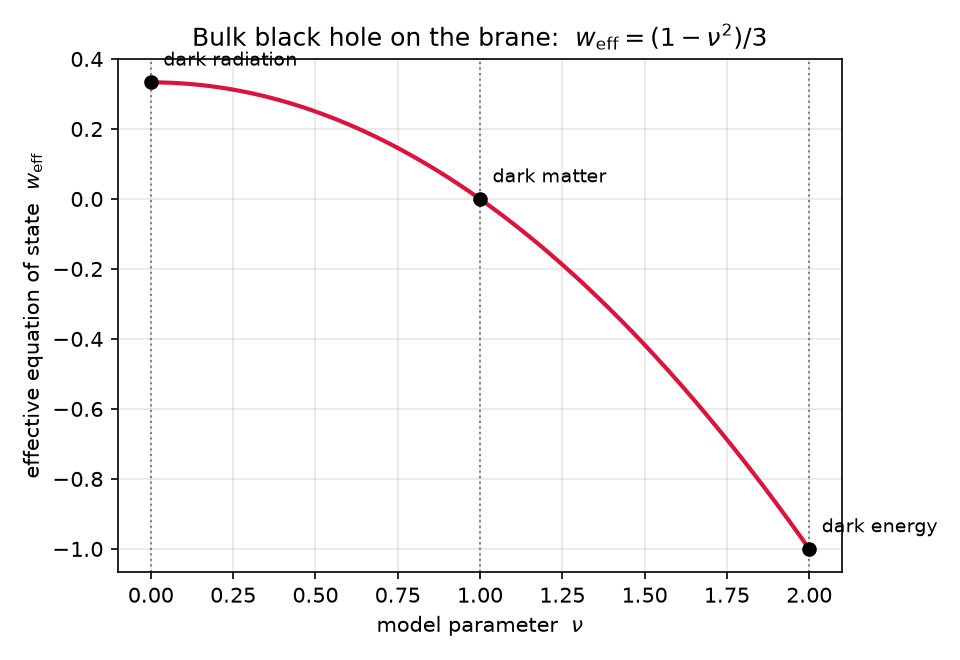
Radiation, matter, and dark energy are no longer three separate things. They are three points on one curve — three behaviours of one five-dimensional configuration, seen from inside four dimensions.
What It Predicts — and Why We Cannot See It
A theory that cannot be tested is not yet science. So the decisive question is: where would this model differ from ordinary cosmology?
The answer is uncomfortable and fascinating at once. If you work out how much the fifth dimension modifies gravity, you find the correction is exactly zero at every scale we can observe — from the size of the observable universe down to the solar system:
| Scale | Modification to gravity |
|---|---|
| The observable universe | 0 |
| A galaxy (10 kpc) | 0 |
| A light-year | 0 |
| The Earth–Sun distance (1 AU) | 0 |
| 1 centimetre | 0.00004 |
| 10 micrometres | ~6 |
| 1 micrometre | ~60 |
For every cosmological purpose, the model is invisible — it predicts exactly what ΛCDM predicts, no gravitational slip, no anomalous growth of structure. It is not ruled out, but it is also not confirmed by cosmology, because cosmology cannot tell the difference.
There is only one place the fifth dimension leaves a fingerprint: below about twenty micrometres, where the modification to Newton’s gravity turns on sharply. In other words, the entire idea is hiding behind a precision measurement of gravity at the width of a hair — a frontier that sub-micron gravity experiments are only now beginning to probe.
An Honest Ledger
So where does that leave the idea?
- Coherent? Yes — a five-dimensional scalar-gravity system can produce a pressureless dark-matter component and a dark-energy component. The cancellation is exact, not approximate.
- Phenomenologically right? Yes — it reproduces the ΛCDM background structure of the universe.
- Confirmed? No — and that is the honest part. Because it is cosmologically invisible, it is vacuously consistent with all cosmological data. It does not yet predict anything that observation has verified that ΛCDM could not also explain.
Two loose ends remain. The model does not explain why dark energy is so extraordinarily small — the famous cosmological-constant problem is untouched. And its only positive signature is a fifth force at micron scales: if a sufficiently precise measurement of Newton’s law finds no deviation there, the idea is falsified, cleanly.
That is a satisfying kind of theory to hold: wrong or right is decided not by elegance or taste, but by a single, well-defined measurement. The dark matter and dark energy we have spent a century chasing may turn out to be neither substances nor mysteries — just the shadow of a dimension we are standing inside, looking out at one slice at a time.
Adapted from the SkyLabs dark-sector series. The underlying model and results are due to Fichet, Megías and Quirós, with the gapped-continuum toolkit from Csáki, Curtin, Kirby and Teresi; the observational constraints are standard literature. Related: Dimensional Slices.