Dimensional Slices: Seeing a Universe as a Stack of Worlds
September 13, 2026 · Updated September 27, 2026
Research Notes
The one geometric move the whole dark-sector series rests on: a higher-dimensional space is a stack of lower-dimensional worlds — and the distinction that matters most, between slicing a world and merely seeing it.
Research Notes — Part 1 of a series on the dark sector as a fifth-dimensional effect.
There is one idea this entire series rests on, and it is surprisingly simple. Before dark matter, extra dimensions, or braneworlds, we need to see this idea clearly, because everything that follows is just this idea taken seriously.
A higher-dimensional space is a stack of lower-dimensional worlds.
We will build that idea from our own world outward, not from a toy world inward. And along the way we meet a distinction that sounds pedantic but turns out to matter: slicing a world is not the same thing as looking at it.
Start with our own three dimensions
Take our ordinary space, with three coordinates: (x, y, z). Now pick a particular value of z — say z = z₀ — and freeze it. What remains is a plane, (x, y): a complete two-dimensional world in its own right.
The key point is where this 2D world sits. It is not a separate universe floating off on its own; it is already inside our three-dimensional space, held at one fixed depth. We, looking from outside, can see the z that its inhabitants cannot.
That is the whole game, and it is worth a picture.
A familiar 2D world: the platform game
The clearest everyday example of a two-dimensional world is a classic side-scrolling game. The player moves left and right along x, and jumps up and down against gravity along y. There is no depth direction to walk into: the entire adventure unfolds on a single sheet.
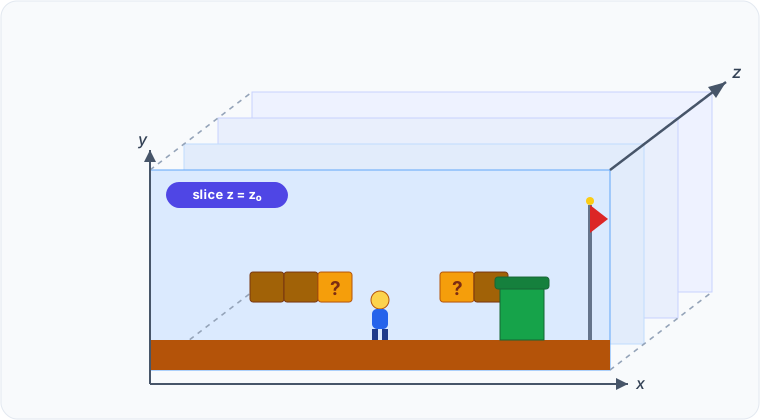
The platform world is a complete two-dimensional universe in its own right — and, in our picture, one plane in a stack of planes, the slice z = z₀ of a three-dimensional space.
The player, the question blocks, the bricks, the pipe, and the goal flag all live on the plane (x, y) — which is the slice z = z₀ of our 3D space. The player sees two directions, x and y; the third direction, z, is invisible to it, exactly as a fifth direction would be invisible to us.
Sweeping the slice rebuilds the world
Change z and you get another plane; change it again and you get another. Sweeping through every value of z fills the whole 3D world with planes. The pattern is always:
a world with N+1 dimensions
    =
a stack of worlds with N dimensions, one per value of the extra coordinate
A three-dimensional world is a stack of two-dimensional planes. A four-dimensional world is a stack of three-dimensional spaces. It is the same move at every level — freezing one coordinate lowers the dimension by one, and the higher-dimensional space is the union of all its slices. No exotic physics, only the geometry of coordinates.
What the 2D creature sees — and why it is not a slice
Now the twist. The player is itself a two-dimensional creature, and its eye is a one-dimensional retina. Suppose it simply looks to its right. Because the retina is a line, it does not see the plane the way we do. It sees a single vertical line of colours:
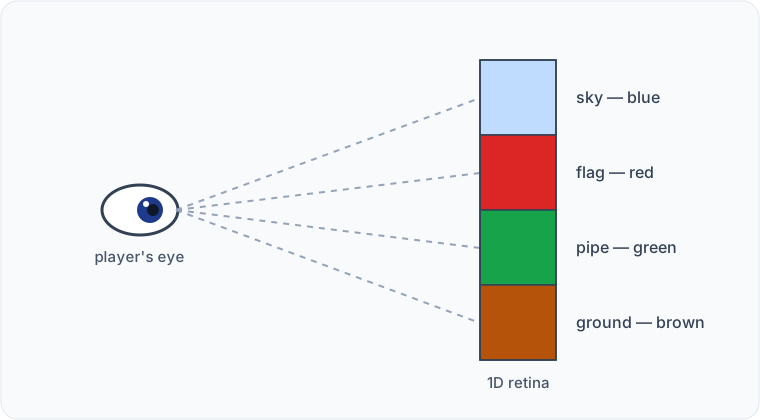
The player’s retina is a line, so the whole plane arrives as a single vertical strip of colour: sky, flag, pipe, ground, top to bottom.
Reading top to bottom, the player finds sky, then flag, then pipe, then ground. The whole two-dimensional world is compressed into a line.
This is where the language makes it easy to blur something important, so it deserves care. That compression is not the slice from before.
- A slice is built by restriction: freeze one coordinate, discard everything not sitting at that value, and keep the rest exactly as it is.
- Vision is built by projection: light from many different points, at many different
x-values, is gathered and folded onto the retina, indexed now by angle rather than by original position.
Both constructions get described as “one dimension lower than the space they came from,” and it is tempting to treat them as the same idea. They are not. The slice is what lets us say our 4D world is literally a piece of a 5D bulk. The projection belongs to a different family of ideas — holography, the reconstruction of a bulk from boundary data — which the series may gesture toward later, but which should not be casually identified with slicing.
The same projection, one dimension up
The same mechanism operates on us. We live in a 3D world, and our retina — or a camera sensor — is a two-dimensional surface, not a line. Light converges through an aperture, rays from different directions land on different points of the sensor, and the 3D scene is compressed into a 2D image. Depth is recovered only indirectly, through cues like parallax, occlusion, and apparent size — never preserved outright.
| 2D creature | us | |
|---|---|---|
| ambient world | 2D: (x, y) | 3D: (x, y, z) |
| retina | 1D line | 2D surface |
| image | projection of the 2D world onto a line | projection of the 3D world onto a plane |
This is the situation made famous by Edwin Abbott’s 1884 novella Flatland, in which a two-dimensional society is forced to reason about a third dimension it cannot perceive. It is a licence for a thought experiment: it lets us ask, from the outside, what a creature inside a lower-dimensional world can and cannot see.
The move is older than relativity
The slice idea is not a curiosity invented for this series. It is standard, centuries-old mathematics, and general relativity already leans on it.
- Intrinsic vs extrinsic (Gauss, 1827). Gauss’s Theorema Egregium showed that the curvature of a surface can be measured entirely from within the surface, without reference to the surrounding space. A creature on a slice can, in principle, measure its own geometry without ever perceiving the extra direction.
- Foliations. The decomposition of a space into a family of slices is called a foliation — the ordinary subject of a classical branch of geometry, not an invention of this series.
- Gauss–Codazzi. These equations describe how a surface bends inside a higher-dimensional space. They are exactly the machinery the later papers use to project five-dimensional gravity onto a four-dimensional slice.
- Nash embedding (1956). Nash’s theorem guarantees that any curved space can be realised as a slice of a higher-dimensional flat space. The extra dimension as an embedding arena is available in complete generality, not just for toy planes.
- ADM (3+1). General relativity already treats spacetime as a stack of three-dimensional spatial slices labelled by time. So “a space is a family of slices” is not exotic physics; it is how one of our best theories is routinely written.
One caution worth stating once: writing a slice as z = z₀ is only a choice of coordinates. The slice is a geometric surface, and the equation merely records that we chose coordinates in which it looks flat. Physical statements must not depend on that choice.
The bridge to a fifth dimension
This is the only machinery the series needs for the next step:
(x, y, z) → (x, y, z, u)The same move that turned a plane into a line lets us read our own three-dimensional space as one slice of a four-dimensional space — and, adding time, as the four-dimensional slice of a five-dimensional world. The extra spatial direction is called u. (The letter w is kept for the equation-of-state parameter p = wρ, so the fifth coordinate and the pressure relation never collide.)
So the question this series asks is not whether such a stack can exist. The mathematics says it can, at no conceptual cost. The question is whether our universe happens to be one of its slices — and whether the things we cannot see, the things we call “dark,” are the shadow of the direction we cannot reach.
That question is the subject of Part 2.
Related: The Dark Sector, Explained.